Visit Paul's websites:
From Computing to Computational Thinking (computize.org)
Becoming a Computational Thinker: Success in the Digital Age (computize.org/CTer)

If you have felt overwhelmed, confused, or even a little anxious about the constant flood of news surrounding Artificial Intelligence lately, you are not alone. It feels like every day a new tool drops, a new headline sounds the alarm, and a new wave of hype takes over the internet.
But beneath all the noise and flashy marketing, a very real, historic transformation is taking place. To truly understand it, we have to look past the dramatic headlines and understand exactly what the technology is, why it is here to stay, and how we can let it help us. The truth is, the current revolution isn’t coming to us in a physical form such as a robot; it is arriving through our computer/phone screens.
We’ll talk about GAI, humanoids, their difference and distinction, substance vs. hype. We also highlight a number of new Computational Thinking (CT) concepts.
The acronym dominating our world right now is GAI, which stands for Generative Artificial Intelligence. Let’s see what GAI is.
Traditional AI are systems built to perform a specific intelligent task—such as facial/voice recognition, fingerprint matching, or self-driving. However, GAI systems are built to interact with people through natural languages, generating content and orchestrating many different tasks to achieve specific goals on their behalf.
GAI systems became widely known to the general public largely due to the late 2022 and 2023 surge in popularity following the introduction of ChatGPT (Generative Pre-trained Transformer) by OpenAI. As a technology breakthrough GAI has brought a new era—an era where we can use our own natural languages to interact with machines and control computations. You chat with GAI where each question/comment by you is known as a prompt.
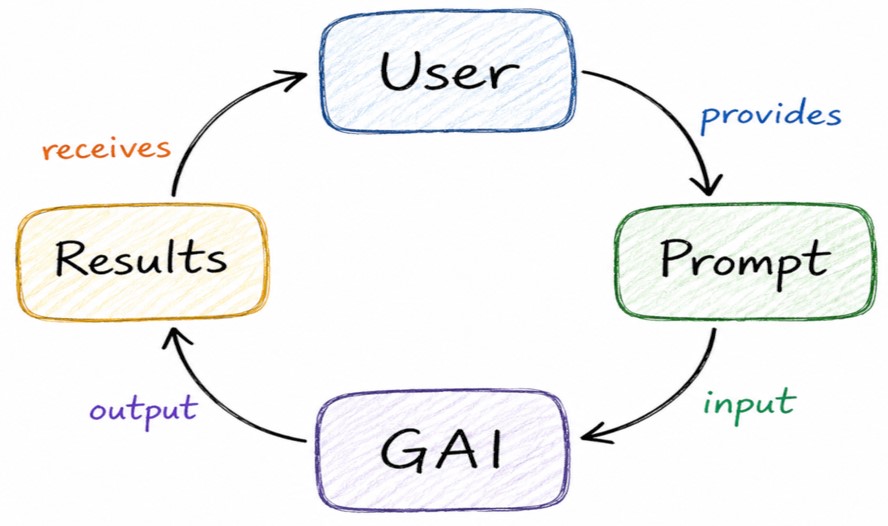
These days, you can enter a prompt in the search box of any web browser and get great answers via GAI right away.
The prompt cycle shows how we chat with GAI. You start with a question or statement. That prompts the GAI system to produce a well-considered, information-rich reply. Keep chatting to dive deeper into an area and get in-depth results. Experienced users know better prompts get more focused answers.

GAI systems use LLMs (Large Language Models) to support natural languages. They also apply a transformer algorithm to generate output based on the input prompt. You can chat using text (more precise) or voice (more convenient). These are their breakthrough properties.
At its core, GAI is a highly advanced type of software. Unlike the traditional computer programs we have used for decades—which can only follow strict, pre-written rules—GAI is designed to create new, original content.
Think of it as a massive statistical pattern-matching engine. By processing millions of examples of human language, computer code, digital artwork, and video, these models learn the underlying structure of how humans communicate and create. When you give a GAI tool a prompt, it doesn’t just copy and paste an answer from the internet. Instead, it uses incredibly complex mathematical probability to predict and create a brand-new response on the fly. It can also orchestrate internal agentic routines to take multi-step actions in order to achieve an overall task, such an ability is in addition to language processing and known as Agentic AI. For example, the prompt “Find flights to Chicago for next weekend, check my calendar for conflicts, and email the options to my manager.” would trigger such agentic actions.
CT concept–Agents vs. Agentic: GAI enables businesses to build app-based agents that chat with customers and automatically service their re-quests. Don’t confuse such agent apps with the agentic architecture within GAI models.

Today, this tech revolution is showing up in our daily lives through three main capabilities:
This isn’t a passing trend or a futuristic prediction; it is an active, permanent shift in how digital work gets done. GAI is a profound technological breakthrough initiating a new technology revolution.
Preparing for Infrastructure: GAI as a Super-Tool
The real purpose of understanding GAI is realizing that it is not something we can simply opt out of. GAI is a super-tool destined to become essential infrastructure in the new age, built to benefit everyone. It is rapidly becoming the new digital foundation—much like the internet in the 1990s or smartphones in the 2000s. To thrive in this new landscape, we need to adapt our mindset in three key ways:As software automates the routine tasks of writing, organizing, and coding, the value of uniquely human capabilities will skyrocket. Empathy, complex problem-solving, real-world collaboration, emotional intelligence, and original creative vision cannot be replicated by data models. Preparing for the GAI world means leaning heavily into the things that make us human.
Separating the Acronyms: GAI is Not AGITo move past public anxiety, we must dismantle a critical linguistic mix-up. GAI is fundamen-tally distinct from AGI, and recognizing this difference eliminates the foundation for irrational fears.
1. Embrace the “Personal Assistant” Mindset
GAI is not an autonomous replacement for human thought; it is an amplifier for human intent. The most successful way to live with GAI is to view it as a tireless, brilliant, but occasionally careless digital assistant. It handles the tedious “first draft” work—formatting data, brainstorming outlines, or writing basic code structures—leaving you with the energy to focus on critical thinking, ethical judgment, and final polishing. Don’t be lazy, maintain your master mindset diligently.

2. Cultivate a Skeptical Attitude
Because GAI works purely on mathematical probabilities and pattern recognition, it doesn’t actually “know” facts the way we do. It can confidently generate information that sounds perfectly reasonable but is entirely inaccurate—a phenomenon known as hallucination. Living with GAI means adopting a healthy skepticism. We must remain the “pilots” in control, double-checking facts and ensuring ethical boundaries are re-spected.

3. Amplify Unique Human Skills
As software automates the routine tasks of writing, organizing, and coding, the value of uniquely human capabilities will skyrocket. Empathy, complex problem-solving, real-world collaboration, emotional intelligence, and original creative vision cannot be replicated by data models. Preparing for the GAI world means leaning heavily into the things that make us human.
Separating the Acronyms: GAI is Not AGI
To move past public anxiety, we must dismantle a critical linguistic mix-up. GAI is fundamentally distinct from AGI, and recognizing this difference eliminates the foundation for irrational fears.
GAI (Generative Artificial Intelligence): Real, current software running on data servers today. It patterns information but has no thoughts, feelings, or awareness.
AGI (Artificial General Intelligence): A theoretical, sci-fi concept of a machine pos-sessing human-level, cross-domain consciousness and biological-style adaptation. That is an ambitious dream as likely and controversial as Mars colonies.
When we look at the reality of GAI, the fear of a Hollywood-style “robot uprising” becomes entirely illogical. GAI is a fancy software app. As you know, apps do not possess biological drives, survival instincts, or egos. They execute instructions in programs. By separating the real tool from the sci-fi myth, we can stop panicking about fictional scenarios and focus on managing real, practical data-era responsibilities.

The Branding Mistake: The Humanoid as a Misleading Symbol
So far we have discussed what GAI is and why the breakthrough is so revolutionary. That provides a solid basis for talking about GAI’s correct public perception. The question is: if GAI is purely computer-based software, why is public perception so distorted?
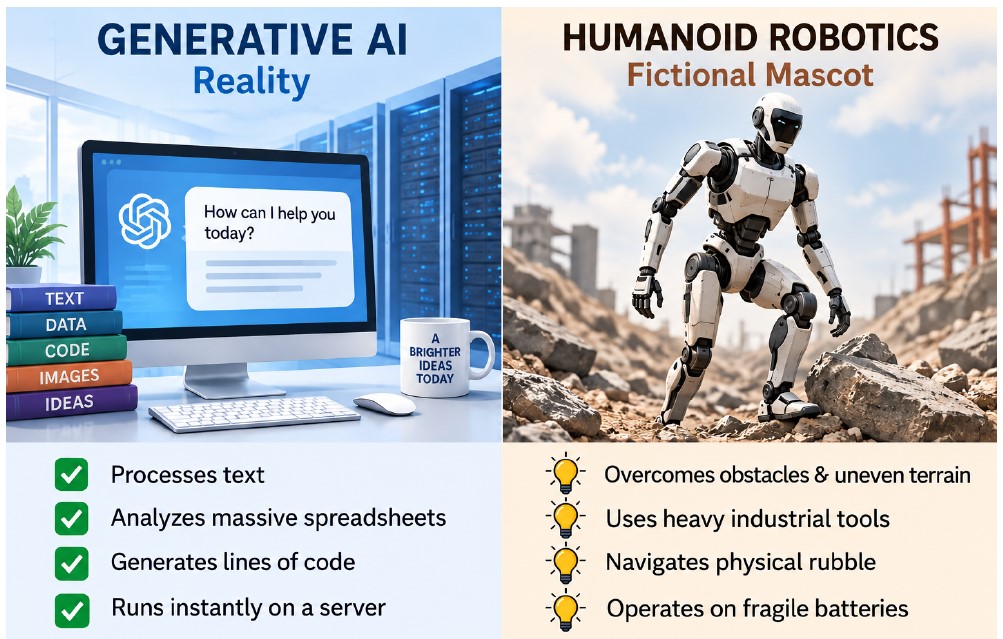
Scroll through the news, go to any AI product convention, and almost every discussion of GAI or the AI revolution is paired with an image of a sleek, bipedal, human-shaped robot. The Mismatch diagram illustrates why it’s wrong. Using the humanoid as the poster child for GAI is highly misleading and ineffective, generating harmful side effects for both the tech industry and society.
By pasting a back-flipping, cartwheeling, martial arts performing, human shape onto a digital software breakthrough, marketing campaigns accidentally evoke AGI—the conscious, living ma-chine. This public imagery hijacking of AI and mislabeling, or misrepresentation, of GAI, help amplify unnecessary public anxiety.
History shows us that when an industry applies a cartoonish or frightening metaphor to a new breakthrough, society wastes decades trying to solve the wrong problem:
- The Electricity Panic: When electrical grids first arrived, corporate smear campaigns branded alternating current (AC) as an untamable engine of death. Terrified homeowners, convinced electricity would “leak” like invisible toxic gas, spent years buying dummy wooden plugs to physically block empty wall sockets while ignoring basic circuit grounding and insu-lation safety.
- The Television Scare: When color TVs launched, manufacturers eagerly bragged in ad-vertisements about the “cathode-ray electron guns” inside the hardware to sound space-age. The public panicked, assuming the entertainment boxes leaked dangerous nuclear X-rays into living rooms, creating a decades-long myth that sitting near a screen caused permanent biological blindness.
When we use the wrong label, our focus gets sidetracked. Presenting GAI through a humanoid shell causes the public to fixate on a fictional mechanical monster, distracting society from the urgent, immediate realities of the software revolution—such as data privacy, copyright protections, data center environmental impacts, and proactive workforce training.

The distortion goes deeper than bad imagery. In recent years, the tech industry has shifted from misleading marketing to outright viral theater. To capture headlines and attract speculative in-vestors, companies regularly stage promotional stunts featuring humanoids engaging in foot races, boxing matches, or tennis games.
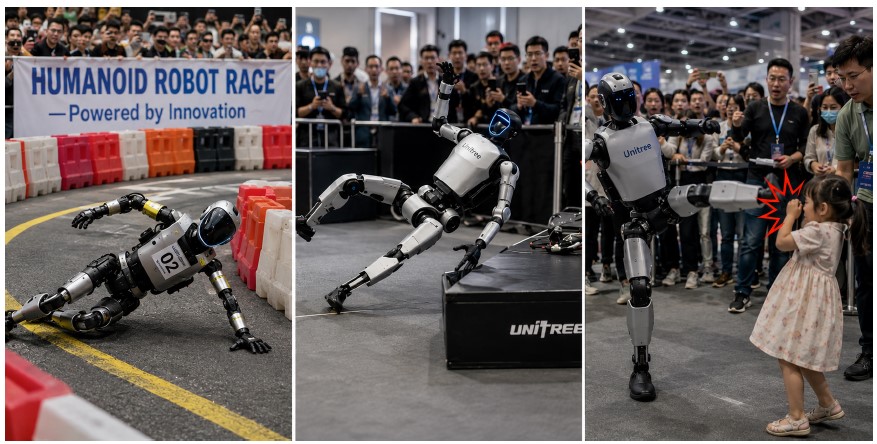
These events are presented as triumphs of adaptive intelligence, leaving the public with the distinct impression that a general artificial mind is steering the robot’s physical coordination in real-time. This is a profound illusion. Staging a robotic boxing match or footrace treats a profound engineering milestone like a carnival sideshow. These spectacles rely on hyper-specific, tightly scripted physical code, controlled laboratory environments, or hidden human teleoperation. They are not examples of a generalized software brain fluidly assessing the physical world. In fact, out of control demos of humanoids tipping over, crashing, or injuring bystanders are no secret.
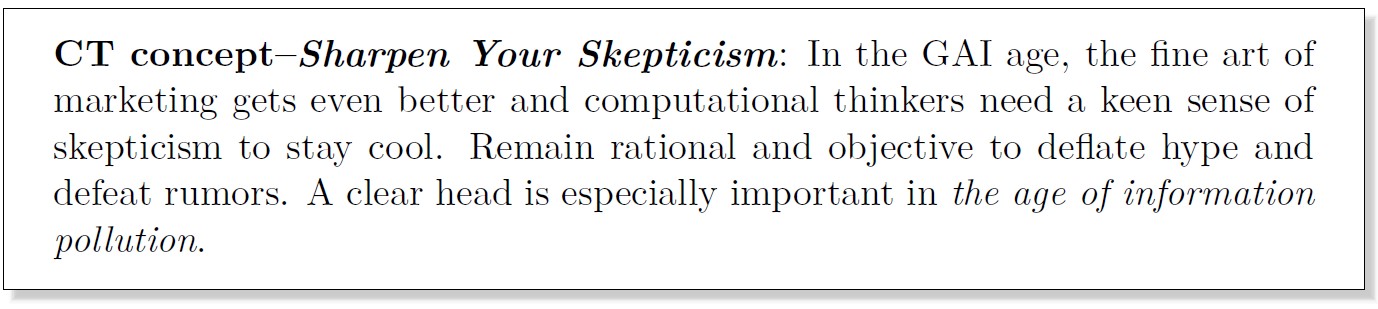
Using athletic spectacles to market GAI distorts reality in two harmful ways:
- It creates a fake hardware bottleneck: It implies that for GAI software to be useful, it must master human athletics or be always deployed in expensive, free-moving human-shaped physical objects. But GAI works best on computers, smartphones, with on-cloud support by huge data centers.
- It weaponizes investor hype: It baits venture capital into chasing flashy physical gimmicks rather than funding the real, foundational infrastructure of GAI—like security algorithms, efficiency models, and data privacy frameworks.
As the public is distracted, governments and regulatory authorities are slow to act in educating the populace and preparing society to better adapt in the GAI era.
So there may be some excessive marketing hype. What’s the big deal? The consequence is a serious massive public distraction. Captivating public attention with shiny, futuristic bipedal robots creates a profound blindness to urgent realities.

While the public and media engage in breathless, speculative debates about whether a humanoid is about to gain consciousness, the real world faces a cascade of immediate crises. Society is actively grappling with skyrocketing heatwave fatalities, accelerating rise of sea levels, persistent waves of infectious diseases, widening economic poverty, and increasingly unaffordable healthcare.
Furthermore, being so misled, people tend to be slow in spotting real impacts of GAI on a personal level. Because GAI can automate many routine tasks, we all need to recognize—sooner rather than later—how employment requirements are changing and how we can adjust accordingly. Fields of training likely to be most affected include entry-level data entry and coding, par-alegal work, copy editing and proofreading, language translation, customer support and technical help desks, and routine office work such as preparing documents and presentations, working with
spreadsheets, bookkeeping, basic accounting, and simple tax-return preparation.
This does not mean that these jobs will disappear. Rather, the skills required to perform them
—and the way people are trained for them—will change.
Using sci-fi theater to hog the headlines acts as an attention sponge, causing society to look away from real and important crises. Furthermore, it actively harms the proper acceptance and
balanced regulation of either field. It forces lawmakers to design reactive policies for hypothetical “killer robots,” completely overlooking immediate algorithmic issues like data privacy, corporate monopolies, and algorithmic bias. Simultaneously, it burdens the genuine robotics industry with absurd, unviable standards of human mimicry, stunting their real utility in dangerous, specialized fields.
Correcting this narrative is not an attack on robotics. On the contrary, humanoid robots are highly useful in specific applications and are a vital engine for making progress in technological integration and advancement.
Logically speaking, a super-intelligent robot does not actually need to take a human shape. It will naturally adopt whatever form factor best fits its designed purpose—whether that is a multi-wheeled warehouse vehicle or a stationary precision manufacturing arm. A bipedal robot may also have small rollers under its feet to become more versatile.
However, the human form does possess unique powers: the power of navigating and func-tioning in everyday environments designed for humans and the power of social inter-actions. To make such powers come true in practical situations, more R&D must be done. Even then, there are limiting factors, such as upfront and operational costs (can be prohibitive), energy source, seamless network access, reliability, and maintenance.
When a machine is shaped like a human, it naturally evokes our deeply ingrained social ten-dencies. It makes us want to look it in the eye, speak to it, and interact with it naturally. There is absolutely nothing wrong with this dynamic. In fact, it is exactly the reason why the humanoid form factor offers a magnificent, natural platform for integration. It serves as the ultimate meeting ground where advanced physical mechanics, computer vision, hearing, other senses, and movement systems can seamlessly combine with natural language processing—namely, GAI.
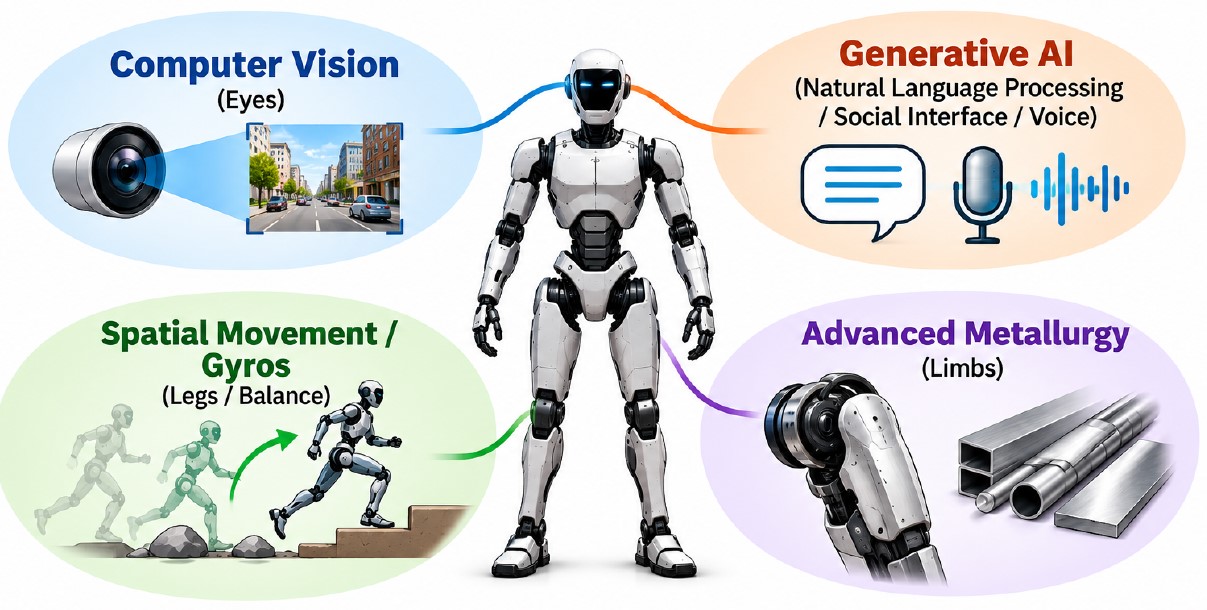
The mistake is not the existence of humanoids, nor is it the integration of GAI into their systems. The mistake is using theater and athletic gimmicks to turn the humanoid into
(1) GAI alone made it possible and/or (2) GAI software requires a two-legged robot to work. Of course, neither is true. In reality, the vast majority of GAI’s functional value will always come through on screens and smart speakers.
The current technology revolution does not walk on two mechanical legs, and it does not need to look even remotely like us to be extremely useful. It is an infrastructure of intelligence, integrating directly into our computing devices, creative workflows, and communication platforms. By chatting with us in our own languages, GAI brings answers, knowledge, information and ideas as well as task execution and newly created contents.
Humanoid robots will continue to advance, carving out their own vital, specialized niche as the ultimate integrated communication and labor platforms. Of course, integrating natural language abilities supported by GAI is important for certain robotic use cases. Meanwhile, GAI will continue to reshape the digital workplace.
Conceptually mixing up humanoids with GAI is wrong and harmful. As media workers, creators, professionals, and members of society, it is the duty of us all to correct this confusion. By stripping away the misleading Hollywood-style packaging and rejecting manipulative viral theater, we can finally stop fearing a fictional shadow—and begin objectively understanding, mastering, shaping, and further developing a historic super-tool together.
So a humanoid is a terrible poster child for GAI. But the question becomes “What is better?” or “Who needs a poster child for GAI?” We know that any image of something close to a living being, a beautiful model avatar for example, won’t do. A mechanical object moving, driving, or flying won’t do either. Instead of being led by marketing/sales forces, we should invent our own poster child as an educated consumer.
So, allow me to put forward an idea and see what everyone thinks. First we designed a logo for GAI. The logo is used to create a GAI Communicator Badge that can represent a wearable GAI connection device.

Then we put that GAI badge on user Joe to lift him up into the GAI age.
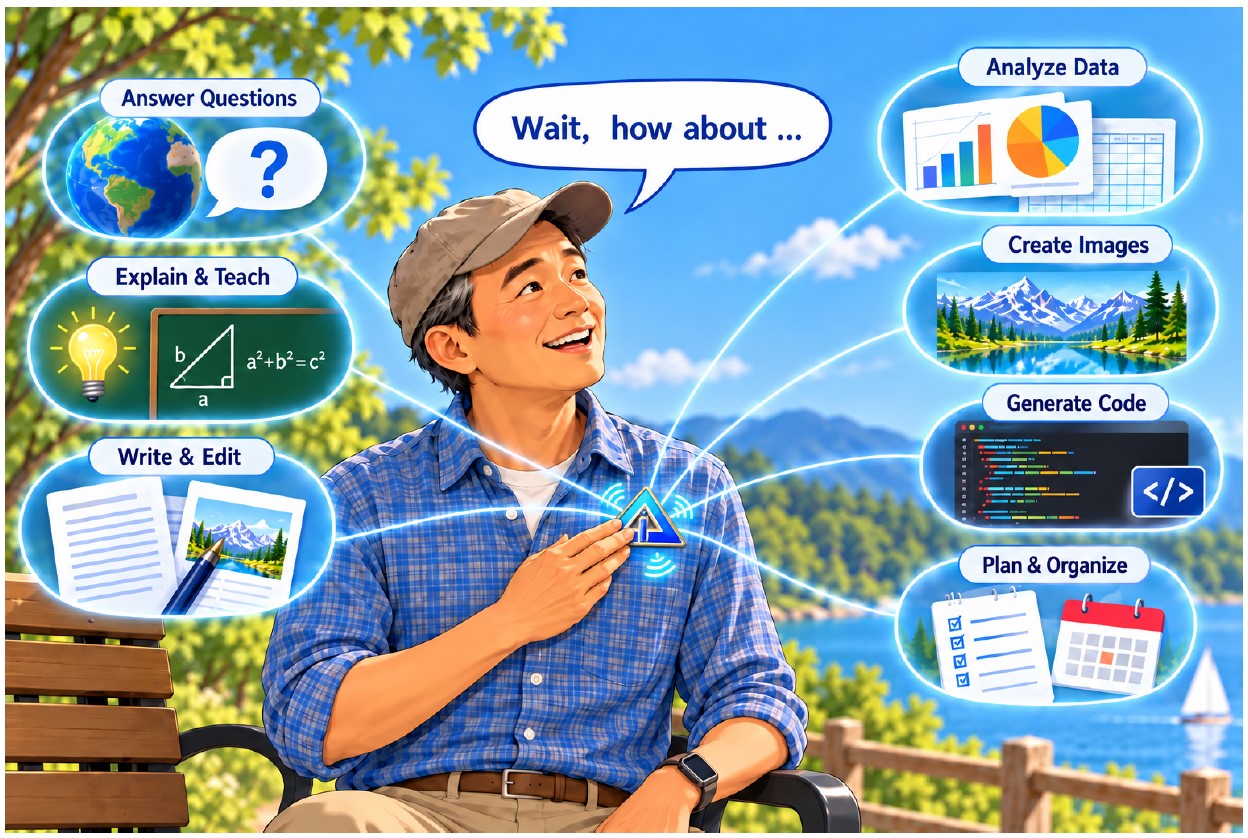
Let us know your reactions, comments, and suggestions. After all, for better or worse, GAI is here to stay.
Note: This article is part of our ongoing Computational Thinking (CT) blog published in around-Kent, an online magazine. Other enjoyable and engaging CT articles can also be found online at computize.org and in the author’s book Becoming A Computational Thinker: Success in the Digital Age. The diagrams here were created with the help of ChatGPT Plus.
ABOUT PAUL
A Ph.D. and faculty member from MIT, Paul Wang (王 士 弘) became a Computer Science professor (Kent State University) in 1981, and served as a Director at the Institute for Computational Mathematics at Kent from 1986 to 2011. He retired in 2012 and is now professor emeritus at Kent State University.
Paul is a leading expert in Symbolic and Algebraic Computation (SAC). He has conducted over forty research projects funded by government and industry, authored many well-regarded Computer Science textbooks, most also translated into foreign languages, and released many software tools. He received the Ohio Governor's Award for University Faculty Entrepreneurship (2001). Paul supervised 14 Ph.D. and over 26 Master-degree students.
His Ph.D. dissertation, advised by Joel Moses, was on Evaluation of Definite Integrals by Symbolic Manipulation. Paul's main research interests include Symbolic and Algebraic Computation (SAC), polynomial factoring and GCD algorithms, automatic code generation, Internet Accessible Mathematical Computation (IAMC), enabling technologies for and classroom delivery of Web-based Mathematics Education (WME), as well as parallel and distributed SAC. Paul has made significant contributions to many parts of the MAXIMA computer algebra system. See these online demos for an experience with MAXIMA.
Paul continues to work jointly with others nationally and internationally in computer science teaching and research, write textbooks, IT consult as sofpower.com, and manage his Web development business webtong.com