

Visit Paul's websites:
From Computing to Computational Thinking (computize.org)
Becoming a Computational Thinker: Success in the Digital Age (computize.org/CTer)

It is complicated to explain what Generative AI (GAI) is. Simply put, traditional AI are systems built to perform a specific intelligent task—such as facial/voice recognition, fingerprint matching, or self-driving. However, GAI systems are built to interact with people through natural languages, generating content and orchestrating many different tasks to achieve specific goals on their behalf.
GAI systems became widely known to the general public largely due to the late 2022 and 2023 surge in popularity following the introduction of ChatGPT (Generative Pre-trained Transformer) by OpenAI.
As a technology breakthrough GAI has brought a new era—an era where we can use our own natural languages to interact with machines, control computation as well as automation with traditional AI. You chat with GAI where each question/comment by you is known as a prompt. Use the prompt to clearly describe a question or task, then GAI will answer or perform accordingly. Enter a well-stated prompt in the search box of any web browser to get great answers via GAI right away.
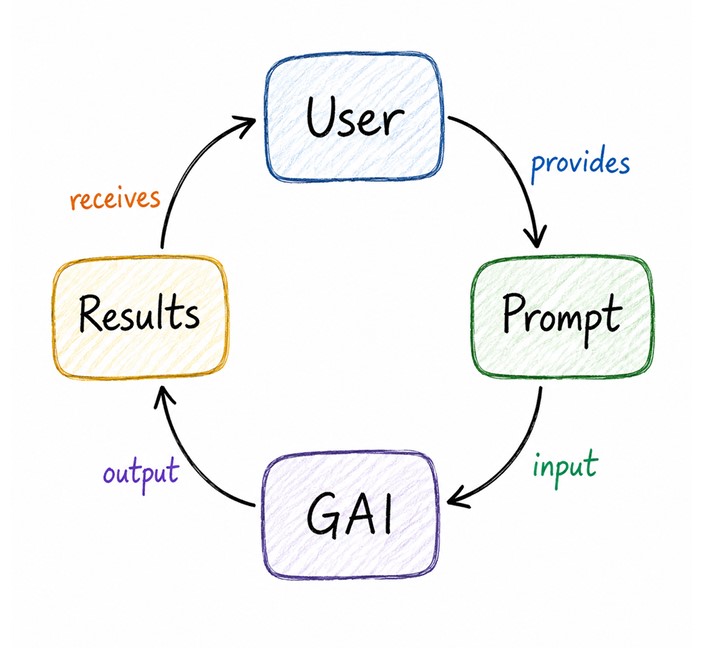
GAI systems are built using extensive LLMs (Large Language Models) and apply an internal algorithm called a transformer to generate output using the prompt as input. The prompt can be typed (more precise) or spoken (more convenient). These are their breakthrough properties.
Now, there is one important point to clarify: GAI is not to be confused with AGI (Artificial General Intelligence), an ambitious dream as likely and controversial as Mars colonies.
As you continue a chat with GAI, it keeps the conversation going in context, just as we would expect. We all hate having to say things repeatedly.
In addition to containing vast amounts of data and information on existing knowledge, GAI systems can also create new original content. These two aspects combined became so powerful and useful that many aspects of technology and our daily lives are being trans-formed.
Yet, the GAI revolution isn’t just a tech shift; it’s a psychological roller coaster. When machines can suddenly converse, compose, reason, code, design, and analyze in seconds, humans don’t just change their ways—they also adapt their emotions. Most people don’t move from “never heard of it” to “expert user” overnight. Instead, we go through distinct stages of learning and feeling. Co-developed as a psychological roadmap for the GAI era, the GAI Adoption Stages model pairs intuitive milestones with the formal mindsets we all experience.
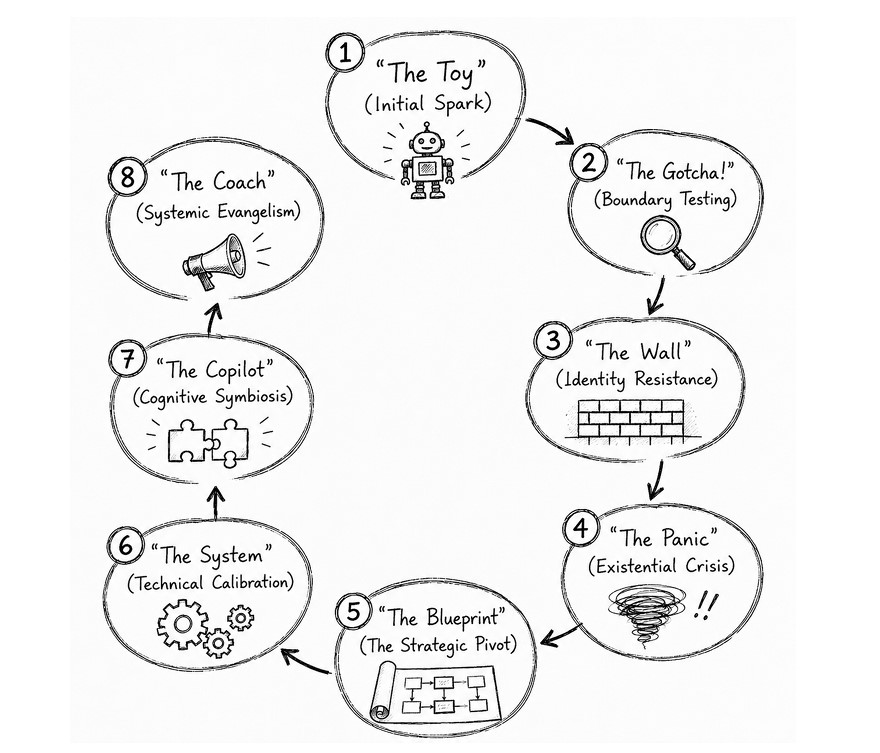
Read through the following adoption stages and ask yourself the diagnostic questions to find out exactly where you—and your friends/coworkers—stand today.
The Vibe: Treating GAI like a fun digital novelty or parlor trick.
The Behavior: You treat GAI like a magical talking dog. You ask it to write a poem about cats in the voice of a mouse, or generate a funny picture. It is highly entertaining, but it doesn’t feel like something that impacts real life.
Diagnostic Question: “Have you tried asking ChatGPT to write a silly rap song or a pirate recipe yet?”
The Vibe: Intentionally feeding the GAI riddles or niche work tasks to expose its flaws and feel relieved.
The Behavior: The skeptic in you wakes up. You give the GAI a highly complex, niche math problem or logic riddle from your specialty. When it gets it wrong or hallucinates (goes off the deep end), you laugh, breathe a sigh of relief, and feel your job is perfectly safe.
Diagnostic Question: “When you deliberately try to trick the GAI and it makes a mistake, do you feel a sense of relief?”
The Vibe: Digging your heels in, pushing for workplace bans, or venting about how tech kills human creativity.
The Behavior: As the technology noticeably improves, frustration sets in. You might actively avoid using GAI tools, write angry social media posts about how “real talent” is dying, or fight for strict corporate policies to ban GAI entirely from your workflow.
Diagnostic Question: “Are you actively avoiding GAI tools or wishing your organization would just ban them entirely?”
The Vibe: The stomach-drop realization that a new GAI update can do in seconds a task that takes you years of training.
The Behavior: The “Oh No” moment. A major new model drops, and you watch it translate a massive document, write flawless code, or draft an enterprise strategy instantly. You feel paralyzed, deeply anxious, and wonder if your degree or career path is on the brink of obsolescence.
Diagnostic Question: “Are you secretly terrified that recent GAI updates will make your career or degree obsolete?”
The Vibe: Mapping out a survival plan based on what GAI can do versus what human traits it completely lacks.
The Behavior: Survival instinct replaces panic. You take out a pen and pa-per to separate what the machine can automate (data crunching, drafting) from what it cannot touch (empathy, human relationships, final account-ability). You choose to double down on your unique human value.
Diagnostic Question: “Have you figured out which parts of your job you can hand off to GAI so you can focus entirely on high-value human skills?”
The Vibe: Stopping the “magical conversation” and treating GAI like a raw data processor with strict rules and templates.
The Behavior: You stop talking to the GAI like a human assistant and start treating it like a highly precise calculator. You master context windows, feed it raw data templates, and enforce strict formatting rules. You stop asking it to “be creative” and start engineering its output.
Diagnostic Question: “Are you building structured prompts with raw data, strict rules, and clear constraints instead of just asking casual questions?”
The Vibe: Seamlessly mixing GAI use in your daily activities so it feels in-visible, like typing or using the internet.
The Behavior: The tool becomes entirely invisible because it is woven into your usual routine. You keep a GAI tab open on your browser all day. You seamlessly pass it repetitive heavy lifting, while you spend your actual energy on strategy, ethics, and final creative judgment.
Diagnostic Question: “Is your GAI tab open all day as an automatic as-sistant for heavy lifting while you handle the final adjustments and ap-proval?”
The Vibe: Building corporate guidelines, creating prompt templates for col-leagues, and pulling others into the future.
The Behavior: You look around and realize that if your team doesn’t adapt, the whole organization falls behind. You become the department cham-pion. You build prompt libraries for your coworkers, lead workshops, and actively help your friends step over “The Wall” and into the future.
Diagnostic Question: “Are you actively spreading the word, training or helping others to adopt GAI faster?”
The author also has a strong personal emotional connection to the GAI revolution.
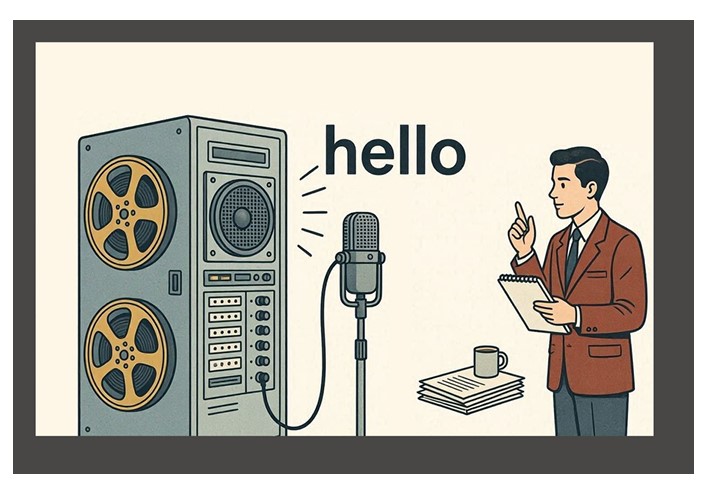
In 1967, Paul arrived in the United States from Taiwan, fresh out of college, to enter the Ph.D. program at MIT on a full scholarship with no service obligations. He decided to pursue computer science and joined MIT’s Project MAC (Multiple-Access Computer) research community. His first term paper explored the concept of a natural-language interface for computers.
Frankly, that was a far-fetched idea at the time. Computing has since taken many enormous steps forward. The professor gave my article a B and said it was an interesting idea. Nearly sixty years later, the GAI revolution has made that idea a reality for all of us.
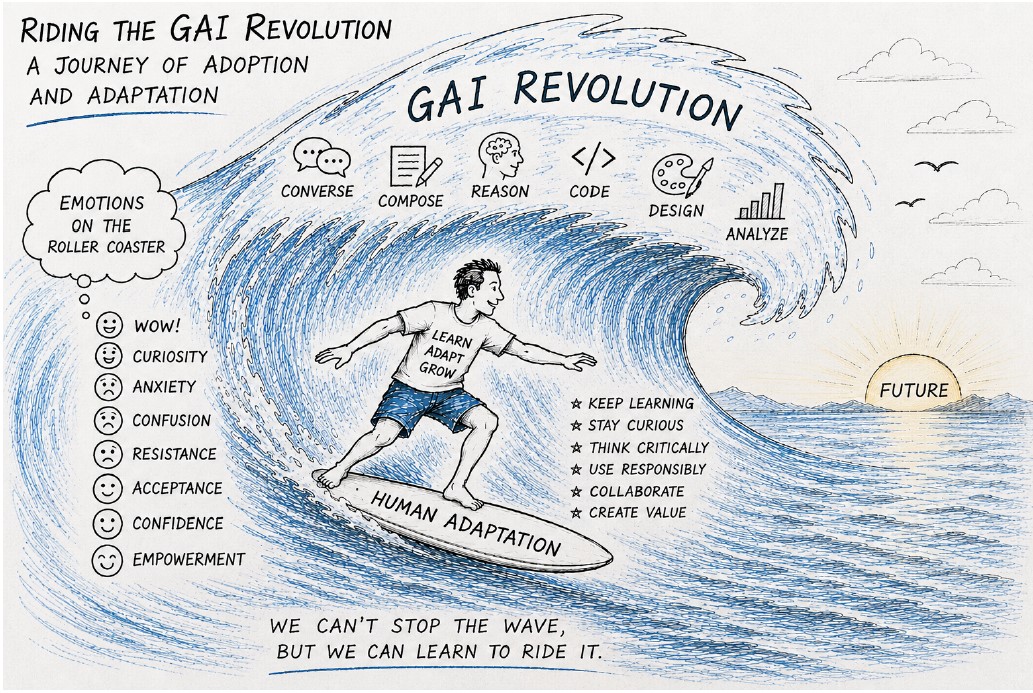
In fact, the author is dedicated to advocating Computational Thinking (CT) as an important mental tool. CT offers a set of powerful methods and ways of thinking—based on ideas from computing—for problem solving, procedure design, trouble shooting, as well as accident prevention, among many other purposes. CT emphasizes objective, speed-and-efficiency, fact-based, unemotional, and unbiased thinking. Such thinking can and should be applied to everyday tasks and decisions, helping us work more efficiently and avoid unnecessary errors. According to CT, when talking with GAI, we need to pay attention to logic and reasoning, steps and details, especially not blindly trust generated answers or results. We should digest the answers to gain a well-rounded understanding. Asking simple questions such as the five W’s—who, what, when, where, and why—can help us examine an answer more carefully. Important facts should also be checked through multiple independent channels. In addition to checking GAI, we should also examine ourselves. Independent of the GAI adoption stage, we should always keep “GAI can make mistakes” in mind. Computational thinkers follow such advice naturally. Therefore, they are well positioned to use GAI more effectively, safely, and productively.
Wherever you are on this list, remember that progression isn’t a race—it’s a process. The goal isn’t to become a GAI programmer; the goal is to shift from viewing GAI as a threat to viewing it as infrastructure. By identifying your current stage, you can demystify the technology, conquer the career anxiety, and start dictating how the tool serves you and others, rather than worrying about when it will replace you, or worse yet, getting sucked in by the GAI enslaving humans nonsense. On the contrary, the GAI revolution might just bring some effective solutions to problems we have created.
For most folks, there is nothing wrong with only a casual exposure to GAI. As the revolution moves forward, many human agents and services will take advantage of it and all of us will receive better services from them as a result. In fact, GAI also brings us a new freedom: freedom from unsatisfied curiosity, freedom from unfulfilled desire to know.
Note: This article is part of our ongoing Computational Thinking (CT) blog published in aroundKent, an online magazine. Other enjoyable and engaging CT articles can also be found in the author’s book Becoming A Computational Thinker: Success in the Digital Age. The diagrams here were created with the help of ChatGPT Plus and Microsoft Bing.
ABOUT PAUL
A Ph.D. and faculty member from MIT, Paul Wang (王 士 弘) became a Computer Science professor (Kent State University) in 1981, and served as a Director at the Institute for Computational Mathematics at Kent from 1986 to 2011. He retired in 2012 and is now professor emeritus at Kent State University.
Paul is a leading expert in Symbolic and Algebraic Computation (SAC). He has conducted over forty research projects funded by government and industry, authored many well-regarded Computer Science textbooks, most also translated into foreign languages, and released many software tools. He received the Ohio Governor's Award for University Faculty Entrepreneurship (2001). Paul supervised 14 Ph.D. and over 26 Master-degree students.
His Ph.D. dissertation, advised by Joel Moses, was on Evaluation of Definite Integrals by Symbolic Manipulation. Paul's main research interests include Symbolic and Algebraic Computation (SAC), polynomial factoring and GCD algorithms, automatic code generation, Internet Accessible Mathematical Computation (IAMC), enabling technologies for and classroom delivery of Web-based Mathematics Education (WME), as well as parallel and distributed SAC. Paul has made significant contributions to many parts of the MAXIMA computer algebra system. See these online demos for an experience with MAXIMA.
Paul continues to work jointly with others nationally and internationally in computer science teaching and research, write textbooks, IT consult as sofpower.com, and manage his Web development business webtong.com

.jpg)


