

Visit Paul's websites:
From Computing to Computational Thinking (computize.org)
Becoming a Computational Thinker: Success in the Digital Age (computize.org/CTer)

In an earlier article on Objectivity, we emphasized the value of staying calm, collected, and attentive to details. These qualities allow us to see situations clearly instead of emotionally. In the digital age, objectivity is not just good practice—it is a powerful defense against scams.
Modern scams are no longer isolated tricks. They are global, technology-driven opera-tions that rely on automation, stolen data, psychological manipulation, and even artificial intelligence. In the U.S., the average person receives about 30 scam attempts each week. Scammers trick you into rushed emotional reactions so as to steal your money, property, assets, personal information and even your identity. By applying Computational Thinking (CT) and practicing objectivity, we can neutralize their evil plots and avoid becoming victims.
This article provides (1) a set of realistic cases showing how scams have evolved, (2) preparedness strategies that build mental immunity, and (3) a simple emergency action plan—a kind of “antiscam penicillin”—for dealing with suspicious calls or messages. This

article is part of our ongoing CT blog published in aroundKent, an online magazine. Other enjoyable and engaging CT articles can also be found in the author’s book Becoming A Computational Thinker: Success in the Digital Age.
Scams evolve rapidly, much like software updates. Below are realistic case summaries placed in chronological order.
2004, Cleveland, Ohio — Bank Verification Email Scam
Mark, 32, received a bank email with realistic logos and a link to a fake login page. In the morning rush, he entered his password. $3,800 was withdrawn before he realized. The phishing ring was never found.
2012, Fresno, California — Tech-Support Pop-Up Scam
Linda, 68, saw a pop-up claiming her computer was infected. A fake “Microsoft technician” took remote control, sold her a “protection plan,” and stole card information—total loss: $2,700. Fear and confusion overrode her objectivity.
2019, Plano, Texas — IRS Robocall Scam
Mr. Williams, 74, was told he owed back taxes and faced arrest. In panic, he bought
$4,000 in gift cards and read the numbers to the scammer. Local police confirmed the scam; perpetrators operated overseas.
2022, Seattle, Washington — “Pig Butchering” Scam
Emily, 45, developed a two-month online relationship with “Daniel.” He guided her to a fake crypto platform. She invested $61,000; the site vanished. The scam was traced to a forced-labor compound in Cambodia.
2023, Phoenix, Arizona — Voice-Cloning Kidnapping Scam
Maria, 52, received a call with a cloned audio of her daughter’s voice crying for help. A ransom was demanded. She verified by calling her daughter’s real number. The scammers used a disposable VoIP line.
2024–2025, San Diego, California — Deepfake Video Scam
David, 38, joined a video call showing deepfake versions of his CFO and executives. Believing their “strategic acquisition” story, he authorized a $2.6M transfer. Only later was the fraud uncovered. This exposed the new frontier of AI-powered impersonation.
The preceding incidents do not begin to describe the extent and scope of the problem. The average American receives around 25-28 scam calls/texts/emails combined per week, totaling about 100 monthly, making the U.S. a global leader in scam attempts, with many adults getting these daily, according to the Pew Research Center and CNET.
Scam losses worldwide surpassed US$1.03 trillion in 2024, according to the Global Anti-Scam Alliance (GASA). The organization also found that nearly half of consumers encounter scam attempts at least weekly–and among those who fall victim, only 4% fully recover their money. In the US the losses in 2024 exceeded $16.6 billion according to the FBI. Worse yet, wide-spread scamming erodes public trust in messages and notices from individuals, businesses and governments. Such loss is immeasurable.
From a CT perspective, scams thrive because of:
Scammers are also increasingly using fast, AI-powered A/B testing (split testing) to rapidly figure out which messages, emotional tactics, or hooks work best to trick people, allowing them to scale successful scam scripts and create highly effective, personalized fraud funnels. They test different greetings, urgency levels, or emotional appeals on small groups, quickly identifying high-converting pitches to deploy broadly, making scams more convincing and efficient.
Here is a table showing the most common scam categories:
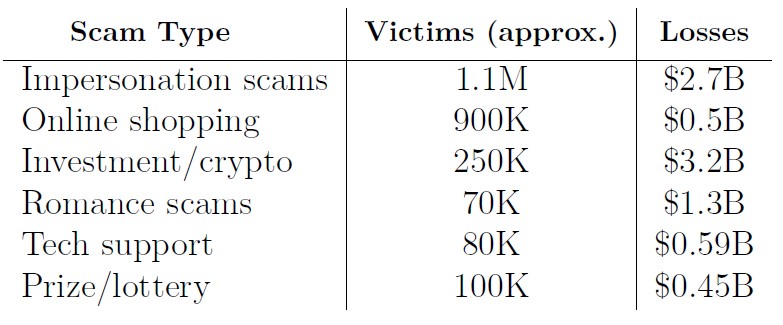
Most people think of scams as small tricks—phishing, fake tech support, romance scams. But scams exist on a wide spectrum, from low-dollar personal frauds to multi-billion-dollar
institutional deceptions. Understanding this landscape clarifies that all scams, regardless of scale, exploit the same underlying vulnerabilities: emotion, trust, complexity, and the lack of independent verification.
Scams can be analyzed across three conceptual dimensions:
Scale of Impact
Mechanism of Deception Across all scales, scams use similar cognitive exploits:
Domain of Operation Common scam domains include:
A few actual examples of big scams can put things in context. Even prestigious institutions, seasoned investors, and scientific experts can be misled when objectivity breaks down. Below are brief summaries of some major scams that made headlines worldwide.
Bernie Madoff Ponzi Scheme (1980s–2008): Madoff, a respected Wall Street figure and former NASDAQ chairman, promised steady, market-beating returns. He fabricated account statements showing consistent profits, even during market downturns. Investors trusted him because of his reputation and exclusivity. In reality, no trading occurred; new investor money was used to pay earlier investors. The scheme collapsed in 2008, revealing an estimated $65 billion in paper losses.
Theranos and the “One Drop of Blood” Claim (2003–2018): Theranos, founded by Elizabeth Holmes, claimed to perform hundreds of laboratory tests from a single finger-prick of blood. The technology never worked, but carefully staged demonstrations, secrecy framed as innovation, and endorsements from generals and former Secretaries of State created an aura of legitimacy. Walgreens invested heavily and planned nationwide rollout. Investigative reporting eventually exposed the deception; the company collapsed and its leadership was convicted of fraud.
Volkswagen Emissions Scandal (2009–2015): Volkswagen programmed diesel engines to detect laboratory testing conditions and temporarily alter emissions performance, passing environmental tests while emitting far higher pollution on the road. Consumers, regulators, and environmental groups were misled by the brand’s engineering reputation. The scandal triggered global recalls, billions in fines, and criminal charges.
FTX and Alameda Research Collapse (2019–2022): FTX, one of the world’s largest cryptocurrency exchanges, portrayed itself as a secure and transparent platform. Behind the scenes, customer funds were secretly funneled to Alameda Research for risky trades, while the company generated fake balance sheets to appear solvent. Charismatic leadership, celebrity endorsements, and crypto hype created a powerful illusion of stability. When the truth surfaced, more than $8 billion in customer assets were missing.
Large-scale scams are not limited to the United States. Around the world, major cases in science, finance, and corporate governance illustrate that deception follows universal cognitive and structural patterns. The same vulnerabilities exploited in everyday scams—trust, authority bias, lack of verification, social proof—also enable billion-dollar institutional frauds.
When we see scams at all scales—from phishing texts to falsified science—patterns emerge:
This unified perspective reinforces a key message of this CT article series:
Objectivity and verification are universal defenses, whether dealing with a suspicious text message or a billion-dollar scientific claim.
Furthermore, we can expose the plot of a typical scam to see how it works step by hideous step. By disrupting it at any intermediate step, the whole scheme falls apart.
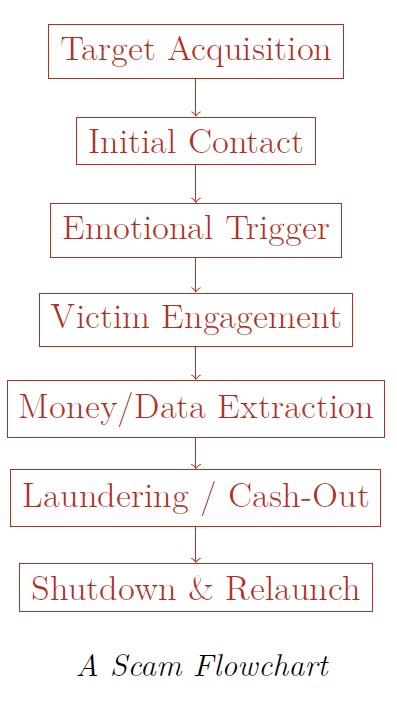
Our goal is to get all of us ready to defend against these hideous scams, big or small. An important CT principle is to preplan for all contingencies. Here, preparedness means developing habits and rules before facing a scam attack. It converts uncertainty into confidence.
When answering the phone, don’t state your name or identity. Just say “Hello.”
If the caller insists on confirming your name, you may reply:
“They are not available. Can I take a message?”

This preserves privacy and can frustrate any potential scammer, buys time, and gives you reason to ask who they are and their detailed contact information which you must check and verify before taking any action.
We all can use modern technology to fight modern scams. AI is now a powerful everyday tool for restoring objectivity in moments of stress. It provides immediate, calm analysis when your emotions are triggered.
When something feels suspicious, go to your Web browser search box, or your favorite AI chatbot, and simply type:
Examples:
AI has seen thousands of scam patterns, government warnings, and reports. It can immediately explain red flags, restoring calm and objectivity. Provide only a brief description; do not include sensitive personal data. AI does not need full details to identify scam patterns. One day soon, you’ll be able to use voice and say “scam check ...” instead of typing.
“Antiscam Penicillin”: Your Action Plan
When receiving a suspicious call or message, you need a simple, repeatable procedure. This is our “penicillin”—a universal scam-cide ordinary people can apply instantly.
Step 1: Pause
Scammers rely on speed. Take a breath. Put the phone down. Stop typing. This reactivates your objectivity. Ask yourself “Do I know this person/organization?”, “Have I got an address or phone number to verify and to get back to them?”, “Can the story they gave be used on many others?”
Step 2: Identify the Emotional Trigger
Ask:
If yes, treat it as suspicious.
Step 3: Disengage Safely
Reply: “Will definitely contact you soon.”
Do not argue. Do not obey instructions. Just disengage.
Step 4: Verify Independently
Any and all information from a scammer can’t be trusted. Use your own prepared toolkit:
Never use the caller provided phone/email, attachment, link, website or app. Legitimate companies and organizations rarely demand immediate action via text/email; instead, they tell you to log into your account directly to handle any issues.
Reporting helps you and others: Contact your bank, your phone carrier, FTC or local police, and/or family and community groups. Each report strengthens collective defense.
Decent People Unite to Fight Back
Scammers form organizations to victimize all of us. We must also get together to fight back. Here we propose that decent people form a united front. All of us can be the “sensors” in a well-organized nonprofit national anti-scam center (scamcide.org for example) which becomes a central reporting portal that can combine:
Such a center could issue real-time national alerts, just like the CDC.
Whistle-Blower Incentives Provide publicly announced rewards for scam whistle blowers. Criminal organizations lack loyalty. Scam insiders can supply:
Rewards and safe reporting channels can bring down entire networks.
AI Tools for Public Protection Provide a publicly available “ScamShieldBot” or “ScamProofBot” that can:
Of course, it is high time for nations to get together and declare war against global scams, their perpetrators, facilitators, and protectors, so there is no place to hide.
In the digital age, scams are a serious and growing problem for individuals and the whole society. Modern scams aim to disrupt our objectivity by triggering fear, urgency, or emotion. The devious techniques are ever changing and more clever as time goes by. No one is immune. But knowledge of deception patterns, preparedness, CT skills, and disciplined habits can help us immensely. The guide is simple:
Objectivity is our built-in shield.
Verification and calm attention can defeat deception.
With shared reporting, whistleblowing incentives, AI assistance, and coordinated institutional reactions, society can become significantly harder to fool. Lastly, a practical and effective anti-scam system to protect all citizens, especially vulnerable individuals, is achievable and urgently needed.
ABOUT PAUL
A Ph.D. and faculty member from MIT, Paul Wang (王 士 弘) became a Computer Science professor (Kent State University) in 1981, and served as a Director at the Institute for Computational Mathematics at Kent from 1986 to 2011. He retired in 2012 and is now professor emeritus at Kent State University.
Paul is a leading expert in Symbolic and Algebraic Computation (SAC). He has conducted over forty research projects funded by government and industry, authored many well-regarded Computer Science textbooks, most also translated into foreign languages, and released many software tools. He received the Ohio Governor's Award for University Faculty Entrepreneurship (2001). Paul supervised 14 Ph.D. and over 26 Master-degree students.
His Ph.D. dissertation, advised by Joel Moses, was on Evaluation of Definite Integrals by Symbolic Manipulation. Paul's main research interests include Symbolic and Algebraic Computation (SAC), polynomial factoring and GCD algorithms, automatic code generation, Internet Accessible Mathematical Computation (IAMC), enabling technologies for and classroom delivery of Web-based Mathematics Education (WME), as well as parallel and distributed SAC. Paul has made significant contributions to many parts of the MAXIMA computer algebra system. See these online demos for an experience with MAXIMA.
Paul continues to work jointly with others nationally and internationally in computer science teaching and research, write textbooks, IT consult as sofpower.com, and manage his Web development business webtong.com

.jpg)


